Roji-en — The Six Historic Gardens
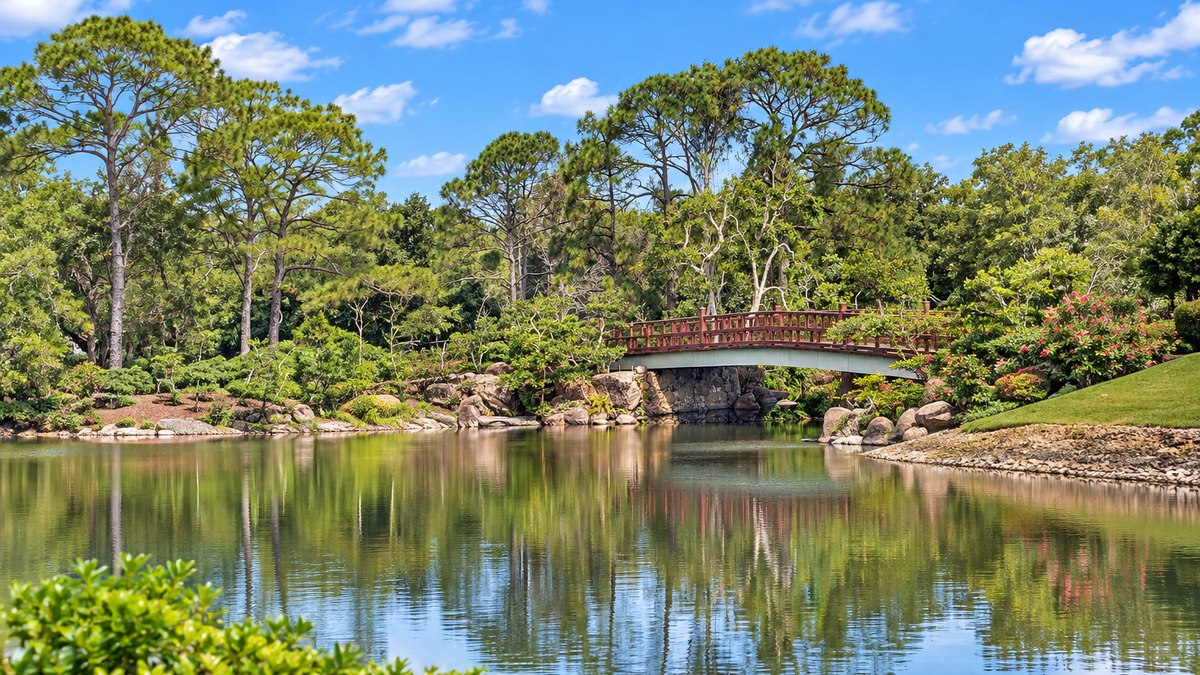
Roji-en, the "Garden of the Drops of Dew," spreads six gardens across 16 acres, each inspired by a different period of Japanese garden design rather than copying a specific real garden. A mile-long trail connects all six, running past pine trees, bamboo groves, waterfalls, and granite boulders along the way.
What's here
- Shinden Garden (Heian period) — a large pond with landscaped islands reached by arched bridges, in the style of aristocratic estate gardens.
- Paradise Garden (Kamakura/early Muromachi) — a Buddhist-influenced stroll garden designed to reveal new views as you walk through it.
- Early Rock Garden and the Karesansui Late Rock Garden (Muromachi period) — dry-landscape gardens using raked gravel and rock arrangements to suggest water without using any.
- Hiraniwa Flat Garden (Edo period) — uses "borrowed scenery," framing distant museum views as part of the garden itself.
- Modern Romantic Garden (Meiji period onward) — blends Japanese design with Western naturalistic planting.
Good to know
Signage is intentionally minimal throughout Roji-en to keep the gardens contemplative — a paper map from the front desk helps if you want to be sure you've seen all six.
Six Periods of Japanese Garden Design, in Order
Roji-en was designed by master garden designer Hoichi Kurisu as a walk through the history of Japanese garden design itself, laid out chronologically rather than mixed together. Construction began in 1993, alongside the museum's new main building, and the gardens were completed in 2001 — nearly a decade of work to bring six distinct historical styles onto a single 16-acre site.
The walk opens with the Shinden Garden, modeled on the aristocratic estate gardens of the Heian period, where a large pond with landscaped islands and arched bridges recalls a style originally meant to be viewed from a boat. From there, the Paradise Garden reflects the Kamakura and early Muromachi periods, built around Buddhist Pure Land imagery meant to offer solace, with a strolling path that reveals new views at each turn rather than a single fixed vantage point.
From Water Gardens to Dry Rock Gardens
The Early Rock Garden marks a shift in the walk toward Zen Buddhist aesthetics, using a dry cascade of carefully placed rocks to suggest a waterfall without any actual water — a technique drawn from Chinese landscape ink painting. The Karesansui, or Late Rock Garden, pushes that idea further still, reducing the landscape to raked gravel and a handful of rocks meant less to look at than to meditate on.
The Hiraniwa Flat Garden, representing the Edo period, brings decoration back into the walk with a stone pagoda, lanterns, and stepping stones, and uses "borrowed scenery" to fold the museum building itself into the view. The Modern Romantic Garden closes the sequence with Meiji-period naturalistic plantings, including irises, blending Japanese design with Western influence for a more open, less formal feel than the gardens that came before it.
Walking Roji-en at Your Own Pace
The mile-long trail connecting all six gardens is deliberately under-signed, which is intentional rather than an oversight — the idea is to let each garden's own atmosphere carry the walk rather than interrupting it with interpretive placards at every turn. A paper map from the front desk is the easiest way to make sure all six gardens have actually been seen, since a few of the transitions between them are subtle enough to walk past without noticing.
Because the six gardens are arranged in chronological order, walking them start to finish gives a rough timeline of how Japanese garden design changed over roughly a thousand years, from the water-centered aristocratic gardens of the Heian period to the dry rock gardens of the Muromachi period and on to the more naturalistic Meiji-era plantings at the end.
See the rest of the park
The Six Gardens is one of 6 featured areas at Morikami Museum and Japanese Gardens.