The Bonsai Collection at Morikami
Bonsai — the practice of training miniature trees into sculptural form over years of pruning and shaping — gets its own dedicated display within Roji-en, letting visitors get close to specimens that are otherwise easy to walk past in a larger garden.
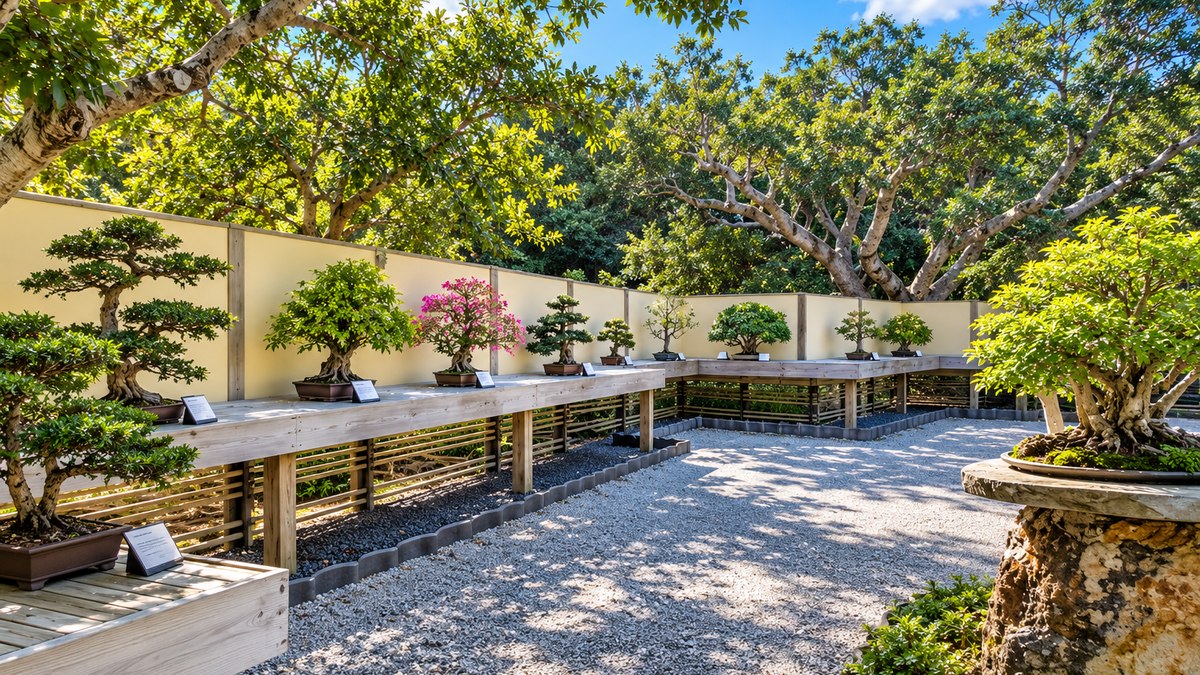
What's here
- A rotating display of trained bonsai specimens set within the garden grounds.
- Included with regular museum and gardens admission — no separate ticket needed.
- Best paired with a slower walk through Roji-en rather than treated as a standalone stop.
Good to know
Bonsai are living, actively maintained trees — please don't touch the foliage or branches, since a single misplaced grip can undo years of training.
The Dr. Ron and Arlene Kessler Bonsai Walk
The bonsai display sits along the Dr. Ron and Arlene Kessler Bonsai Walk, a dedicated stretch within Roji-en built specifically to showcase the collection rather than scattering specimens throughout the wider gardens. Grouping the trees together this way lets visitors move slowly from one to the next, comparing forms and species side by side in a way that would be harder to do if they were spread across all 16 acres.
Each specimen on the walk represents years, and often decades, of deliberate shaping — trunks bent into windswept angles, branches wired into cascading forms, or canopies pruned into the dense, cloud-like silhouettes associated with more formal upright styles. The result is a collection that rewards a second and third look, since small details in a tree's structure are easy to miss on a first walk-through.
Internationally Certified Collection
Morikami's bonsai collection holds certification from the World Bonsai Friendship Federation, an international body that recognizes public bonsai gardens meeting its standards for collection quality and care — a distinction earned in 2013 that places Morikami's display among a select group of certified bonsai gardens worldwide rather than treating it as simply a decorative garden feature.
That certification reflects the ongoing horticultural work behind the display: bonsai require continuous attention long after their initial shaping, including regular pruning, wiring adjustments as branches grow, and periodic repotting to manage root growth in a confined container — upkeep that happens year-round, whether or not visitors are on-site to see it.
The Patience Behind Every Tree
What separates bonsai from ordinary container gardening is time — a specimen on display today may have been in training for longer than many visitors have been alive, shaped gradually rather than pruned into its current form in a single session. That slow timeline is part of what the Kessler Bonsai Walk is built to communicate, showing off not just a finished shape but the decades of incremental decisions that produced it.
Returning visitors sometimes notice subtle changes in a specimen from one visit to the next — a branch trained a little further, a canopy filled in slightly more — which is really the only way to appreciate bonsai as a living art form rather than a static display.
See the rest of the park
Bonsai Collection is one of 6 featured areas at Morikami Museum and Japanese Gardens.